Kidney cancer: A doctor’s perspective and a patient’s experience
Urology Week is observed across Europe from 28 September to 2 October. Each year, the EAU dedicates the week to a different urological issue of importanceRead more
Urology Week is observed across Europe from 28 September to 2 October. Each year, the EAU dedicates the week to a different urological issue of importance to the public. In 2026, the focus is on kidney cancer and the need to “break the silence” around a disease that can remain without clear symptoms for a long time.
Article written by: Indrė Ereminė, Communications Specialist, Lithuanian Urological Society (LT)
Kidney cancer is one of the cancers that can remain without significant symptoms for a long time. Some tumours are discovered incidentally during abdominal ultrasound, computed tomography (CT) or other imaging performed for an entirely different reason. However, this does not mean that unexplained or persistent symptoms should be ignored. This year’s EAU campaign specifically encourages people to be aware of possible signs and risk factors and to consult a doctor if they have concerns.
In this article, we look at kidney cancer from two perspectives. Assoc. Prof. Aušvydas Patašius, urologist at the National Cancer Centre and vice-president of the Lithuanian Urological Association, discusses how kidney cancer is diagnosed and treated today, what has changed in medicine, and what further improvements are needed in Lithuania. Patient Jonas Gulbinas shares his personal experience, from the first symptom he initially did not consider significant to the diagnosis of an almost 10cm kidney tumour.

According to Assoc. Prof. Aušvydas Patašius, one of the most important characteristics of kidney cancer is that the disease can develop without clear symptoms for a long time. As a result, many kidney tumours are discovered incidentally during abdominal ultrasound or other imaging performed for entirely different reasons.
This is also important when discussing screening. There is currently no population-wide screening programme for kidney cancer because there is insufficient evidence that such a programme would provide a net benefit to the general population. This makes it particularly important to ensure that an incidental finding is not lost within the healthcare system and that the patient reaches a specialist in a timely manner.
The doctor points out that, in practice, the pathway from an initial finding to treatment is not always as smooth as it could be. When a renal mass is detected, it should be clear what further investigations are required, when the patient should see a urologist and how quickly a treatment decision should be made.
At the same time, the approach to treating kidney tumours has changed significantly. In the past, finding a tumour often meant removing the entire kidney. Today, particularly for smaller tumours, there is a much greater emphasis on preserving as much healthy kidney tissue as possible. This may involve partial nephrectomy, while minimally-invasive techniques, including robot-assisted surgery, are increasingly used. In selected cases, tumour ablation may be an option, while active surveillance may be appropriate for some older patients or those with multiple comorbidities, particularly when the tumour is slow growing.
The 2026 EAU Guidelines on Renal Cell Carcinoma also emphasise individualised treatment decisions, alternatives to surgery, preservation of kidney function and greater patient involvement in treatment decisions.
Therefore, according to Assoc. Prof. Patašius, there is not always a single “right” treatment option. For example, in a 70-year-old patient with a 3cm kidney tumour, surgery, ablation or active surveillance may all be considered. The decision depends on the characteristics of the tumour, its biological behaviour, kidney function, the patient’s age and comorbidities, as well as the individual’s priorities and preferences.
The patient’s perspective is therefore crucial. When several evidence-based treatment options exist, patients need to understand how they differ and the potential benefits and risks of each. A patient should not simply be a passive recipient of a doctor’s decision.
An even greater shift has occurred in the treatment of advanced kidney cancer. Several decades ago, treatment options for metastatic disease were very limited. Today, combinations of immunotherapy and other systemic treatments have fundamentally changed the situation. For some patients, long-term disease control can be achieved, while some may experience extended periods without active treatment.
However, new treatment options do not mean that all questions have been answered. There is still no biomarker that can accurately predict in advance which treatment will be most effective for an individual patient. Immunotherapy can also cause immune-related adverse events, making careful monitoring and collaboration between specialists essential.
According to Assoc. Prof. Patašius, Lithuania needs to focus not only on access to modern treatment but also on monitoring how the healthcare pathway works in practice: how much time passes between the initial detection of a tumour and treatment, what outcomes are achieved at different centres, and how follow-up care is organised.
In the doctor’s view, more complex kidney tumour surgery should be concentrated in centres with greater experience, while multidisciplinary teams should help guide treatment decisions in more complex cases.
Finally, when discussing prevention, Assoc. Prof. Patašius emphasises that prevention should not be understood as a guarantee that cancer will not develop. However, there are risk factors that people can influence, including smoking, obesity and uncontrolled high blood pressure.

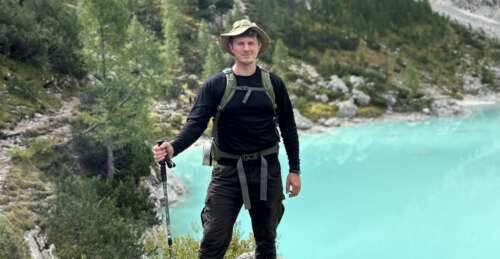
Jonas Gulbinas’ story did not begin with pain in the kidney area or with any suspicion that he might have cancer. Until his diagnosis, he says, he knew practically nothing about kidney cancer. His first symptom was widespread itching. Because of it, Jonas consulted dermatologists and later an allergist, but no clear cause was identified. He was then advised to see a gastroenterologist, but he kept postponing the appointment.
“My biggest mistake was that I waited far too long. The itching did not really bother me, I travelled a lot, exercised and climbed mountains. I saw dermatologists and an allergist, but they found nothing. I was advised to see a gastroenterologist, but I kept postponing the appointment for a year,” Jonas recalls.
Eventually, in June 2026, he consulted a gastroenterologist. Blood tests and an abdominal ultrasound revealed an abnormality in his left kidney, and he was referred for magnetic resonance imaging (MRI). The MRI was performed on 12 June, and on 15 June Jonas learned that there was an almost 10cm tumour in his left kidney.
“My first reaction was: this cannot be true. Is it fatal? It was very difficult. You start thinking about what will happen to your life, whether you will need chemotherapy, how much time you have left. It was very difficult to wait that week for the urologist’s consultation because I did not know what was going to happen,” he recalls of the first days after his diagnosis.
Given the size of the tumour and enlarged lymph nodes, stage IV disease was initially suspected. Jonas then had to wait for the results of a biopsy and additional investigations. This period of waiting, uncertainty and not knowing what was happening in his body was one of the most difficult stages of his illness.
“I simply could not believe that I could have such a large tumour. I had recently been climbing mountains and exercising, and I felt I was perhaps in the best physical shape of my life. I had no pain on the left side, nothing that would have made me think about my kidneys,” Jonas recalls.
He also emphasises another aspect of his experience: how important it was that investigations and consultations proceeded quickly after the diagnosis. The so-called “green corridor” helped him undergo the necessary tests, receive specialist consultations and understand the next steps within a short period of time.
“It helped me enormously that everything happened quickly. I knew what would happen next – if the stage was less advanced, there would be one pathway; if it was more advanced, another. When you know what is happening and what the doctors are going to do next, you have hope. Clear communication from the doctors and knowing that I was being looked after were very important to me,” Jonas recalls.
Investigations carried out at the end of June showed that the initially suspected stage IV disease was not confirmed – no metastases were found, and surgery could therefore be planned. On 8 July, Jonas underwent removal of his left kidney, the tumour and the lymph nodes. Further treatment with immunotherapy was subsequently started.
The speed of his recovery after surgery also surprised Jonas. Although the procedure involved a large incision, he had expected to spend considerably more time in hospital and in bed.
“The incision was about 20cm long, so I thought I would be in bed for several weeks. But I was already standing up and walking on the second or third day. After two or three weeks, I was walking normally again, and my energy is gradually returning. That really surprised me,” Jonas says.
Nevertheless, the disease has changed his everyday life. For now, he has had to put active sports and mountain climbing on hold, limit physical exertion and conserve his energy. He has not yet returned to work, and he receives immunotherapy every three weeks.
“At the moment, I am in energy-saving mode. I cannot lift anything, and for now I mostly walk. The sports and activities I was used to have to wait. I receive immunotherapy every three weeks. I have to adapt to this new situation and learn to listen to my body and my doctors,” he says.
The experience has also changed Jonas’ attitude towards his health. He plans to pay more attention to his diet, physical activity, regular health checks and his doctors’ recommendations. But the most important message he would like to share with others relates to his own mistake – waiting too long.
“I would definitely advise people not to ignore what is happening in their bodies. If something changes and you do not know why, find out. I thought I could wait because the itching did not stop me from living my life. Now I understand that it is better to see a doctor and find out what is going on than to postpone it for years. It is also important to take care of yourself, avoid harmful habits and exercise at least sometimes. Love yourself, take care of yourself and enjoy life. Optimism and a positive outlook also help, both when you are healthy and when you are facing challenges,” Jonas says.
His story is not about suggesting that every case of persistent itching means kidney cancer. It is about something else – a symptom whose cause remained unclear for a long time, and a decision that Jonas himself now views differently.
“My biggest mistake was delaying.”

Kidney cancer can remain without clear, disease-specific symptoms for a long time. It is often discovered incidentally during ultrasound, computed tomography or another imaging examination performed for an entirely different reason. Therefore, the absence of symptoms does not necessarily mean that there is no problem with the kidneys.
At the same time, new or persistent unexplained changes in the body should not be ignored. Blood in the urine, unexplained pain in the side or lower back, unexplained weight loss, persistent fatigue, fever or other new symptoms can have many possible causes and do not necessarily indicate kidney cancer. However, their cause should be investigated, particularly if the symptoms persist or recur.
There is currently no population-wide screening programme for asymptomatic kidney cancer. Public awareness therefore remains important: knowing the possible signs of the disease, understanding risk factors and not delaying medical assessment when unexplained or persistent changes occur.
It is also important to understand that a diagnosis does not mean that treatment options have run out. Today, kidney cancer treatment is tailored to the tumour’s size and extent, the patient’s overall health and other individual factors. For smaller tumours, depending on the circumstances, it may be possible to remove only the tumour and preserve part of the kidney; active surveillance or ablative treatment may also be considered. Treatment options for advanced disease have expanded significantly, including modern systemic therapies and immunotherapy.
The central message of Urology Week is therefore not to encourage people to look for disease where there is none. It is an invitation to be informed, recognise changes and not delay when there is a reason to seek medical advice. Detecting the disease earlier can significantly influence treatment options and a patient’s future. Prevention cannot guarantee that cancer will not develop. But reducing risk, paying attention to one’s health, responding to persistent symptoms and seeking timely assessment are steps we can take today.
Kidney cancer is a significant cancer burden in Lithuania. According to the National Cancer Centre, almost 700 new cases of kidney cancer are diagnosed in the country each year. Men are affected more often than women, and the highest incidence is seen among people aged 50–70.
Diagnosing kidney cancer can be challenging because the disease often causes no clear symptoms in its early stages. Some tumours are discovered incidentally during investigations carried out for other health reasons. There is therefore no single symptom that allows a person to recognise kidney cancer on their own. However, blood in the urine, pain in the lower back or side, unexplained weight loss, persistent fever or other new and unexplained changes in the body are reasons to consult a doctor and determine their cause.
Lithuania does not currently have a population-wide screening programme for kidney cancer. As a result, diagnosis largely depends on clinical assessment, investigations performed because of symptoms or other medical indications, and the patient’s decision to seek medical attention. Risk factors include smoking, overweight and obesity, high blood pressure, diabetes, chronic kidney disease, exposure to certain chemicals and hereditary predisposition.
Kidney cancer is a disease worth understanding because its onset can be difficult to notice. Urology Week 2026 provides an opportunity to speak more openly about kidney cancer: to understand the risk factors, pay attention to changes in health and, when these changes persist or remain unexplained, not delay seeking medical advice.
Posted: 23/09/2026